
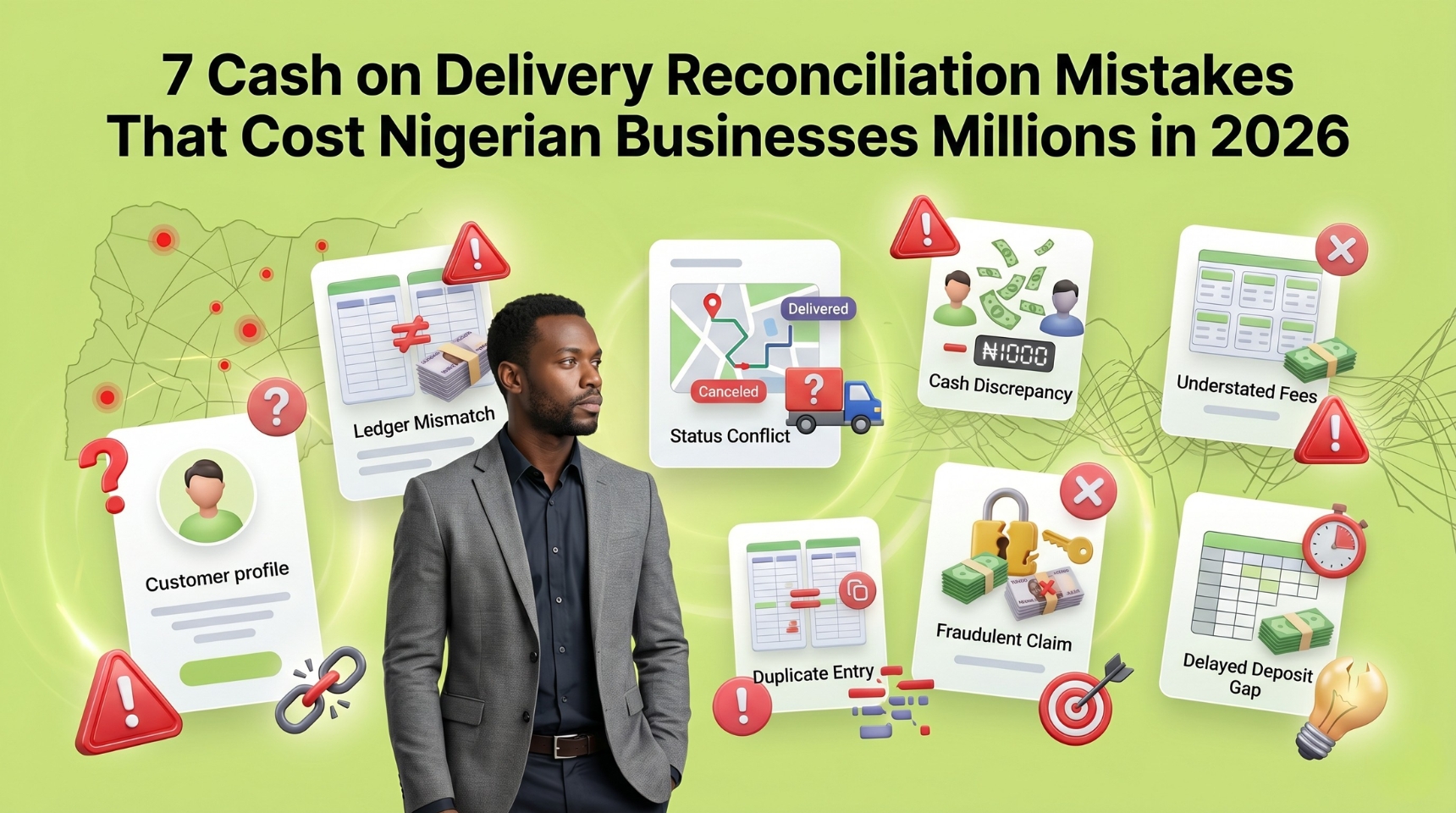

Every week, Nigerian business owners discover troubling patterns in their delivery operations: missing cash, unexplained shortfalls, and delivery agents who can't account for collections.
Despite implementing cash on delivery reconciliation processes, many businesses continue hemorrhaging money through avoidable mistakes.
Across Lagos, Port Harcourt, and Abuja, eCommerce businesses processing 100–500 monthly deliveries report average monthly discrepancies ranging from ₦50,000 to ₦300,000. For logistics companies handling multiple clients, these losses multiply exponentially.
The most frustrating part? Most of these losses stem from preventable reconciliation errors that business owners don't even know they're making.
This article exposes the seven most expensive cash on delivery reconciliation mistakes Nigerian businesses make today—and provides actionable solutions to eliminate each one.
Mistake #1: Reconciling Weekly Instead of Daily
Why This Costs You Money
Many Nigerian business owners schedule COD reconciliation sessions once or twice weekly, believing this saves time. The reality is drastically different.
When you wait a week to reconcile cash collections, delivery agents handle dozens of transactions, making it nearly impossible to trace specific discrepancies.
A Lagos-based fashion retailer processing 200 monthly deliveries discovered this the hard way. By reconciling weekly, they consistently found ₦15,000–₦25,000 in unexplained variances each session. When confronted, their delivery agents couldn't remember specific transactions from five days prior, making resolution impossible.
The Fix: Implement Same-Day Reconciliation
Require delivery agents to remit and reconcile cash at the end of each working day. This approach offers multiple benefits:
Fresh memory: Agents remember every transaction and can explain discrepancies immediately
Smaller amounts: Daily reconciliation involves manageable cash amounts
Quick detection: Identify problems within 24 hours
Better cash flow: Faster access to collected funds
Use systems that support daily reconciliation workflows, automated reminders, and real-time tracking.
Mistake #2: Trusting Manual Spreadsheets for Cash Tracking
The Hidden Dangers of Excel Reconciliation
Many Nigerian SMEs still rely on Excel spreadsheets for COD tracking. While it seems cost-effective, it introduces serious risks:
Data entry errors: ₦45,000 becomes ₦54,000
Formula mistakes: One wrong cell breaks calculations
Version conflicts: Multiple files create confusion
No audit trail: Changes are not tracked
Manipulation risk: Data can be altered unnoticed
A Port Harcourt logistics company uncovered ₦180,000 in cumulative errors over three months—caused by spreadsheet mistakes and minor fraud.
The Fix: Use Automated COD Tracking Systems
Adopt delivery management systems that:
Capture data directly from delivery agents
Automatically match payments to orders
Flag discrepancies instantly
Maintain a clear audit trail
This eliminates manual errors and improves accountability.
Mistake #3: Failing to Verify Payment Before Marking Orders Complete
The Costly Assumption
A common mistake: marking orders as “completed” without confirming payment.
Days later, reconciliation reveals shortages. Agents may claim:
Customer will pay later
Payment was via transfer (but never received)
This gap creates financial losses.
The Fix: Mandatory Payment Confirmation
No order should be marked complete without payment verification:
COD: Cash must be counted physically
Transfers: Must reflect in your account
Partial payments: Must be documented clearly
Enforce a strict payment-before-completion policy.
Mistake #4: Ignoring Small Discrepancies
The “It’s Just ₦500” Mentality
Small discrepancies often get ignored—but they signal deeper problems:
Weak processes
Testing behavior by dishonest agents
A business ignored ₦500–₦1,000 weekly discrepancies. Within months, losses grew to ₦15,000 weekly.
The Fix: Zero-Tolerance Policy
Investigate every discrepancy immediately
Document all issues and explanations
Identify patterns early
Create clarity in reconciliation rules
Every naira must be accounted for—no exceptions.
Mistake #5: Not Photographing Cash During Handover
The “He Said, She Said” Problem
Disputes often arise:
Agent claims ₦85,000 handed over
Cashier records ₦78,000 received
Without proof, resolution becomes impossible.
The Fix: Visual Documentation Protocol
Implement photo verification:
Before delivery: Starting cash/inventory
During remittance: All collected cash displayed
After counting: Final verified amount
Use smartphones and WhatsApp for easy documentation. Add GPS timestamps where possible.
Mistake #6: Mixing Personal and Business Cash
The Commingling Catastrophe
Agents often mix business cash with personal spending:
Fuel purchases from COD money
Incorrect recollection of expenses
Missing funds during reconciliation
This creates confusion and financial leakage.
The Fix: Strict Cash Separation
Use separate envelopes/bags for business cash
Document expenses immediately
Provide petty cash advances
Enforce same-day settlement
Clear rules eliminate confusion and improve tracking.
Mistake #7: No Consequences for Repeat Discrepancies
The Accountability Gap
Repeated discrepancies without consequences create bad habits.
Agents learn that explanations are enough—no accountability.
The Fix: Progressive Consequence Framework
First occurrence:
Verbal warning
Process review
Second occurrence:
Written warning
Reduced delivery assignments
Third occurrence:
Performance improvement plan
Fourth occurrence:
Termination
Consistency is key—rules must apply to everyone.
Building a Leak-Proof COD Reconciliation System
Successful Nigerian businesses share these practices:
Daily reconciliation discipline
Use of automation tools
Clear documentation of all transactions
Consistent accountability enforcement
Proactive monitoring of trends
A business losing ₦100,000 monthly can recover:
₦1.2 million annually
₦3.6 million over 3 years
Fixing these mistakes has a direct and compounding financial impact.
Take Control of Your Cash Collections Today
Cash on delivery reconciliation doesn’t have to be stressful or error-prone.
With the right systems and processes, it becomes:
Predictable
Transparent
Scalable
NovatraCloud helps Nigerian businesses:
Automate reconciliation workflows
Detect discrepancies instantly
Track agent performance
Maintain full audit trails
Ready to eliminate cash leakages?
Start your free trial today and take full control of your delivery operations.